
Your Child's Brain on Music: The Benefits of Music for Early Childhood Development
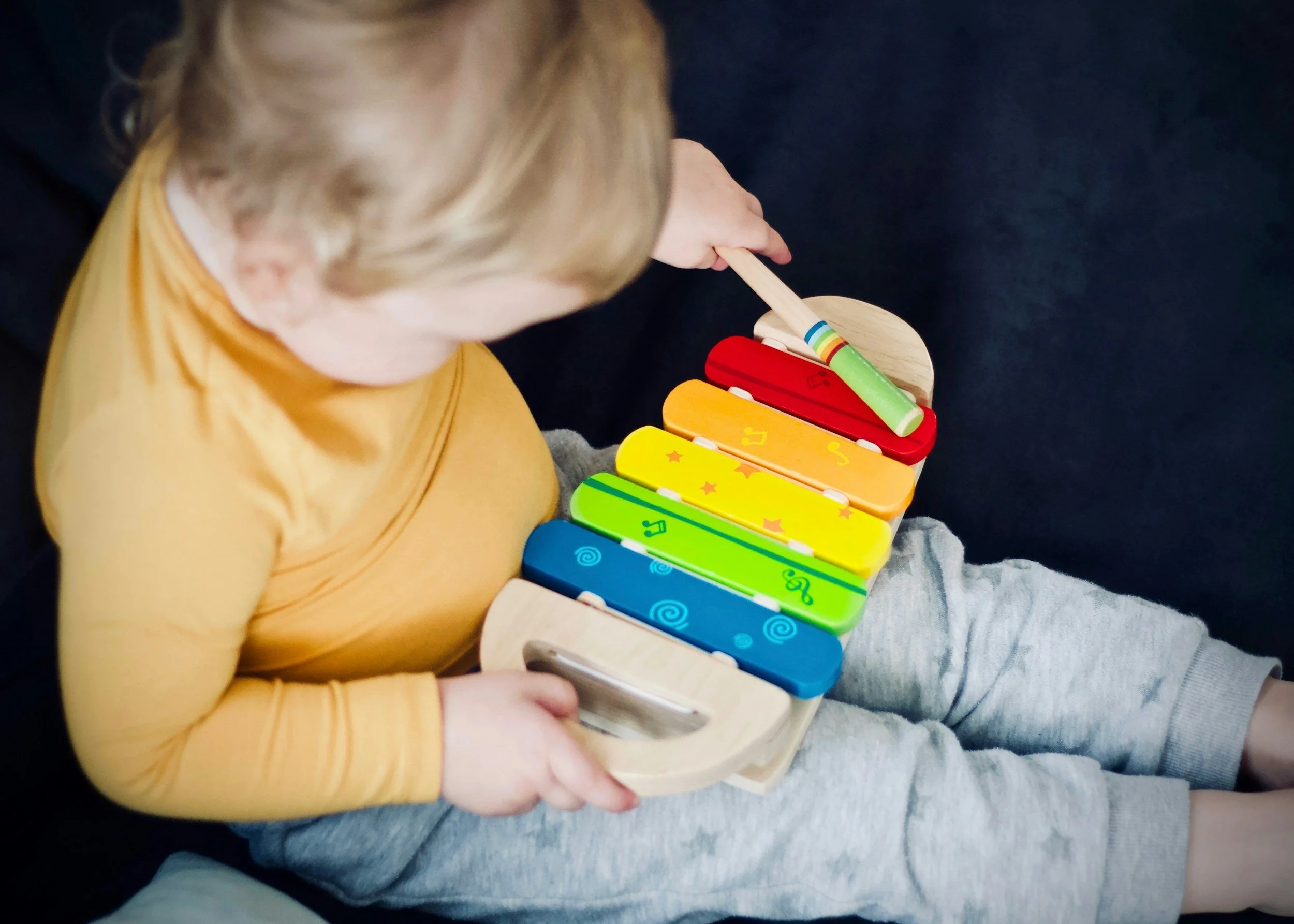
There's a reason every culture on earth, going back as far as we can trace, sings to their babies. Long before a child can speak, they can feel a rhythm, settle into a lullaby, and light up at a familiar tune. Music in early childhood is essential to a developing brain. Here's what researchers have found about what music actually does for your little one.
Music and language grow up together
The parts of a child's brain that process music and the parts that process language are deeply intertwined. When your child claps to a beat or fills in the last word of a song, they're exercising the very same circuits they'll use to read and speak (state-of-the-art review, 2023).
The connection is strongest in one beautiful place: rhythm. Researchers have found that young children with stronger rhythm skills tend to have stronger "phonological awareness" — the ability to hear and play with the individual sounds inside words, which is one of the best early predictors of reading (Politimou et al., 2019). In that same research, rhythm was the strongest musical predictor of phonological awareness, while melody best predicted early grammar.
And this isn't only a matter of which children happen to be musical. When researchers gave three-year-olds structured musical activities, the children measurably improved across multiple areas of phonological awareness — including rhyming and breaking words into syllables (Cambridge Applied Psycholinguistics, 2016). In other words, music doesn't just go along with language development. It appears to help build it.
Quick Science: Why Rhythm Is a Reading Skill in Disguise
To read, a child eventually has to hear that "cat" is made of three separate sounds — c-a-t. That's phonological awareness. Clapping syllables, bouncing to a beat, and chanting rhymes are all secret rehearsals for exactly that skill. Every "ba-na-na" you clap out is early literacy in a party hat.
What's happening inside the brain
Part of the reason music is so powerful is that it lights up the whole brain at once. When a word arrives wrapped in a song, a child's auditory cortex processes the sound, the motor regions engage with the rhythm, and language centers handle the meaning — all together. That multi-area workout helps create stronger, more connected neural pathways, which is part of why children often remember information better when it's set to music (for example, try to recall the alphabet without singing it. See?).
Even in infancy, the effects show up early. Babies regularly exposed to music show stronger neural processing of sound patterns, which supports phonetic discrimination — the building block of a growing vocabulary. It's one of the most-studied inputs in all of early development.
The Mailbox Melodies Method
Every track in your child's monthly Mailbox Melodies is built on this science. The repetition that toddlers crave is exactly how those sound patterns get wired in. The hand motions pair movement with melody to light up more of the brain. The themed, slow-paced songs give language a rhythmic home so it sticks. I didn't choose music because it's cute (well, maybe a little lol). I built this whole experience around what music does.
It's not just about getting smarter
I want to be careful here, because music's gift to your child is so much bigger than reading scores. Some of its most precious benefits never show up on any test.
Music is one of the earliest ways children learn to regulate their emotions. A slow, calm song can bring a wound-up toddler back down. An upbeat one can lift a flat morning. Over time, children who experience this begin to reach for music themselves as a tool for soothing and shifting their mood — a skill that serves them for life.
Music is also profoundly social. Singing together, taking turns, waiting for the chorus, moving in sync — these are tiny lessons in connection and self-control. And the simplest benefit of all: when you sing with your child, you are bonding. Making eye contact, that giggle at the silly verse, the snuggle during the lullaby. The neuroscience is wonderful, but the connection is the whole point.
Try This at Home
- Lean into repetition. Sing the same songs over and over. Your toddler isn't bored — their brain is busy laying down pathways with every repeat.
- Movement. Clap the syllables of their name. March, sway, tap. Pairing movement with music deepens the learning (and burns off some energy).
- Use music to shift the mood. A consistent wind-down song before nap or bed becomes a powerful, regulating cue over time.
- Narrate with rhythm. Make up little songs for daily routines — a cleanup song, a hand-washing song. Children remember what they sing.
- Sing often (good or bad). Your child does not care if you're off-key. They care that it's you. Your voice is their favorite instrument.
The gentle takeaway
When you expose your children to music, you're doing something that looks simple, but is actually extremely important. You're feeding language, wiring the brain for reading, teaching emotional regulation, and saying I love you in the oldest language we have. All at once.
That's the learning magic I try to send to your mailbox each month because for a growing child, music is one of the most natural and powerful ways to learn.
References
- The Association between Music and Language in Children: A State-of-the-Art Review (2023). PMC.
- Politimou et al. (2019). Born to Speak and Sing. Frontiers in Psychology.
- Music effects on phonological awareness development in 3-year-old children (2016). Applied Psycholinguistics.
- Tierney & Kraus. Auditory Neuroscience Lab, Northwestern — rhythm and language.